
Introduction
Life sciences digital marketing is not the same as standard B2B marketing. In this sector, audiences are more technical, sales cycles are longer, and every claim must be handled with care. A life sciences company may need to persuade scientists, procurement teams, quality leaders, regulatory stakeholders, and executives at the same time. That makes digital marketing far more than a traffic exercise. It becomes a trust-building system.
Whether you work in biotech, pharmaceuticals, medtech, diagnostics, laboratory services, CROs, or CDMOs, your digital presence has to do three things well: explain complex value clearly, support credibility with evidence, and guide buyers through a long evaluation process.
This is where life sciences digital marketing matters most. When done well, it helps companies attract the right audiences, educate them with high-value content, strengthen brand authority, and turn interest into qualified opportunities. When done poorly, it creates confusion, weakens trust, and fails to support serious buying decisions.
This guide explains how to build a stronger life sciences digital marketing strategy with the right mix of SEO, content, website experience, compliance awareness, lead generation, and performance measurement.
What Is Life Sciences Digital Marketing?
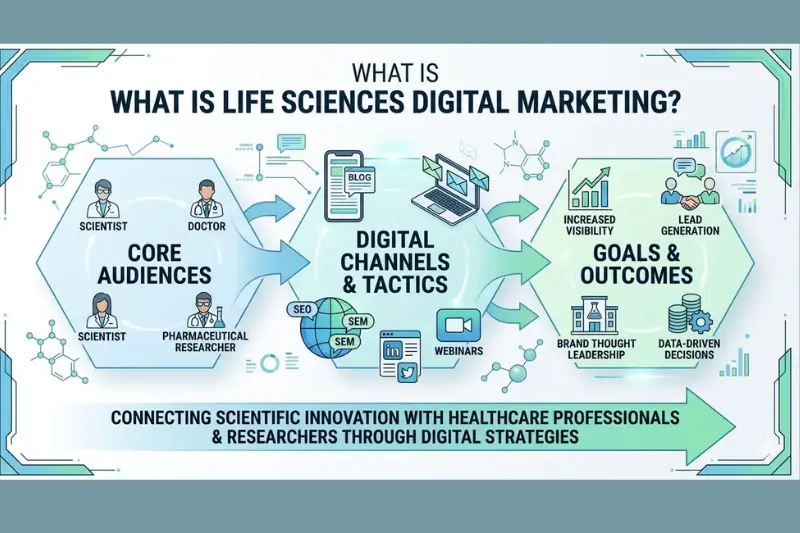
Life sciences digital marketing is the use of digital channels, content, search, paid media, websites, email, and analytics to reach and influence audiences in scientific and regulated industries.
Unlike general marketing, it must balance:
- Scientific accuracy
- Regulatory awareness
- Technical depth
- Clear communication
- Long-term trust building
It is used by organizations such as:
- Biotechnology companies
- Pharmaceutical manufacturers
- Medical device brands
- Diagnostics companies
- Contract research organizations
- Contract development and manufacturing organizations
- Lab technology and research service providers
The goal is not simply to get more clicks. The goal is to attract the right people, answer their questions, reduce uncertainty, and support informed decisions.
Why Life Sciences Digital Marketing Is Different
Life sciences buyers are rarely impulsive. Most decisions involve careful research, internal review, and multiple stakeholders. A scientist may care about performance data. Procurement may focus on price, supply reliability, and vendor risk. Quality teams may want documentation and validation support. Executives may care about scalability and return on investment.
That means a single landing page or generic brochure-style website is rarely enough.
Key differences in life sciences marketing
- Buying cycles are often long and complex
- Products and services can be highly technical
- Trust and evidence matter more than hype
- Regulatory review may affect content speed
- Different stakeholders need different information
- Brand credibility often depends on expertise, data, and transparency
A successful life sciences digital marketing strategy respects all of these realities.
May be you like it:
Hi Tech Nails: Stylish, Fun, Long-Lasting Nail Tips Today
Renas Tech: Easy-to-Use Tools for Learning and Work Success
Tech Tales Pro-Reed: Beginner-Friendly Tech Guides Today
Core Elements of a Strong Life Sciences Digital Marketing Strategy
Audience Segmentation
One of the biggest mistakes in life sciences marketing is treating the audience as one group. In reality, different stakeholders need different messages.
Common audience groups include
- Scientists and researchers
- Procurement and sourcing teams
- Quality assurance and regulatory professionals
- Clinical or laboratory decision-makers
- C-suite leaders and investors
- Distribution or strategic partners
Each group has its own concerns, vocabulary, and evaluation criteria. Good marketing speaks to each audience without diluting scientific credibility.
Example
A biotech supplier selling assay solutions may need:
Technical content for lab professionals
ROI-focused messaging for operations leaders
Quality documentation for compliance teams
Simple summaries for executive buyers
That is why role-based messaging matters so much in life sciences digital marketing.
SEO Built Around Search Intent
SEO in life sciences should focus on relevance, expertise, and intent rather than just keyword volume. Many valuable searches are highly specific and lower in volume, but they come from serious buyers or researchers.
High-value keyword types include
Informational keywords
Example: how to choose a CDMO for biologics
Commercial investigation keywords
Example: best life sciences digital marketing agency
Solution-aware keywords
Example: biotech content marketing strategy
Brand and comparison keywords
Example: CRO marketing vs biotech marketing
SEO best practices for life sciences
- Build content around real questions your audience asks
- Use clear page structure with useful H2 and H3 headings
- Add internal links between related topics
- Include supporting visuals, charts, or process explanations where useful
- Optimize title tags and meta descriptions naturally
- Avoid thin content and keyword stuffing
Strong SEO in this space is about becoming a credible source, not chasing shortcuts.
Content Marketing That Educates First
In life sciences, content works best when it helps readers understand, evaluate, and act. Thin promotional blogs usually underperform because scientific audiences can spot fluff immediately.
Content types that work well
- Educational blog posts
- White papers and technical guides
- Case studies
- Application notes
- Product comparison pages
- Regulatory explainers
- Webinars and expert interviews
- FAQs and glossary pages
What high-performing content does
- Answers specific technical or business questions
- Uses plain English without oversimplifying the science
- Supports claims with evidence, examples, or clear logic
- Matches the reader’s stage in the buying journey
- Helps internal stakeholders share information across teams
A helpful article can attract attention, but a complete content ecosystem builds authority over time.
Website UX and Trust Signals
Your website is often the first serious evaluation point. In life sciences, a weak website does more than hurt conversions. It can damage credibility.
Important trust signals include
- Clear explanation of what you do
- Strong technical and scientific messaging
- Case studies or proof of outcomes
- Certifications, standards, or compliance details
- Team expertise and author credibility
- Publications, partnerships, or research references
- Easy access to contact, support, and documentation
UX priorities for life sciences websites
- Clean navigation
- Fast load times
- Mobile-friendly design
- Clear calls to action
- Easy access to technical content
- Logical journeys for different audience types
A scientist should be able to find specifications. A procurement lead should be able to assess fit. A senior decision-maker should quickly understand value. Great UX supports all three.
Lead Generation That Matches Long Sales Cycles
Life sciences buyers often need time before speaking to sales. That means digital marketing should not force hard conversion too early.
Instead, build a progressive path.
- Example lead journey
- Visitor finds an educational article through search
- Reads a related case study or application page
- Downloads a technical guide
- Receives a follow-up email sequence with relevant resources
- Returns later to request a consultation or demo
This approach respects the buying process and improves lead quality.
Effective lead magnets in life sciences
- Technical checklists
- Vendor evaluation guides
- Compliance or validation templates
- Benchmark reports
- Case study collections
- Webinar recordings
The best lead generation feels useful, not pushy.
Paid Media With Precision
Paid search and LinkedIn advertising can work well in life sciences, especially when targeting niche audiences. But budget can be wasted quickly if campaigns are broad or messaging is too generic.
Good uses of paid media
- Reaching high-intent searchers
- Promoting webinars, white papers, or case studies
- Supporting account-based marketing campaigns
- Retargeting previous website visitors
- Expanding visibility for priority services or product lines
Common paid media mistakes
- Sending traffic to weak landing pages
- Using broad keywords with low commercial intent
- Writing ad copy that sounds vague or overly promotional
- Ignoring compliance review
- Measuring success only by clicks
Paid campaigns perform best when they connect tightly to audience needs and landing-page relevance.
Compliance-Aware Content Workflows
Compliance is one of the biggest realities in life sciences digital marketing. But it should not become an excuse for slow, ineffective communication.
A better approach is to build structured workflows.
Practical ways to improve compliance speed
- Create an approved messaging library
- Define what types of content need review
- Separate educational content from promotional claims
- Maintain version control for regulated materials
- Build review processes early, not after drafting
- Train marketing teams on approved language boundaries
This reduces friction while protecting accuracy and consistency.
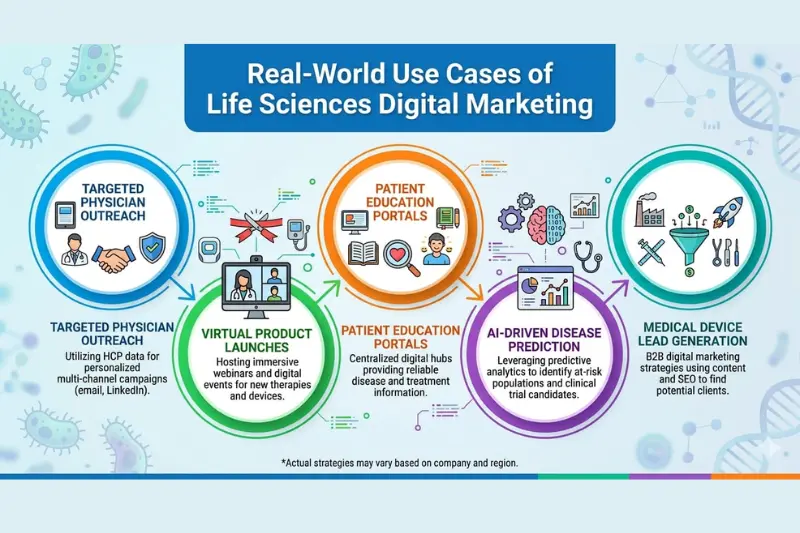
Real-World Use Cases of Life Sciences Digital Marketing
Biotech startup
A biotech startup can use SEO and thought leadership content to build visibility, explain its platform, and attract early partners or investors.
CDMO or CRO
A CDMO can use account-based marketing, technical landing pages, and case studies to target procurement and operations teams looking for specialized manufacturing capacity.
Diagnostics company
A diagnostics brand can create educational content around testing workflows, validation, accuracy, and implementation to support both awareness and trust.
Medical device company
A medtech company can use segmented content for clinicians, buyers, and administrators while improving website UX to support product evaluation.
Research tools provider
A lab technology company can drive organic traffic with application-specific content, buying guides, and high-intent product pages.
Common Challenges in Life Sciences Digital Marketing
Even strong companies face real obstacles.
Common challenges
- Explaining complex science clearly
- Aligning marketing with legal or regulatory review
- Reaching multiple stakeholders with different priorities
- Measuring ROI over long sales cycles
- Producing enough high-quality content consistently
- Standing out in crowded, technical markets
- Balancing depth with readability
These challenges are normal. The goal is not perfection. The goal is a repeatable strategy that improves over time.
Common Mistakes to Avoid
Many competitors touch on strategy, but fewer clearly explain what not to do. Here are some of the most important mistakes to avoid.
- Writing generic content that could apply to any industry
- Using too much jargon without explanation
- Making the website feel like a digital brochure
- Ignoring search intent and audience questions
- Publishing without a clear compliance workflow
- Targeting traffic instead of qualified relevance
- Failing to support claims with proof or examples
- Creating one message for all audiences
- Measuring vanity metrics instead of business impact
Avoiding these mistakes alone can improve performance significantly.
How to Measure Success
Traffic is useful, but it is not enough. Life sciences companies need better indicators of quality and progression.
Metrics that matter more
- Organic traffic from relevant keywords
- Engagement with technical or educational content
- Conversion rates on key landing pages
- Lead quality by source
- Account engagement across multiple stakeholders
- Sales-qualified opportunities influenced by marketing
- Pipeline contribution
- Time to conversion
- Return visits from target accounts
Measurement should reflect the true buying journey, not just surface-level activity.
A Practical Framework for Better Results
A simple way to think about life sciences digital marketing is this:
Attract
Use SEO, thought leadership, paid search, and targeted campaigns to bring in the right audience.
Educate
Publish clear, credible content that answers questions and supports evaluation.
Build trust
Strengthen your website, proof points, messaging, and user experience.
Convert
Offer useful next steps such as guides, consultations, demos, or technical discussions.
Optimize
Track performance, learn what works, and improve over time.
This framework is practical, scalable, and much stronger than random content publishing.
May be you like it:
Nurture Tech Tips EmbedTree: Easy Guide for Beginners
Discover Major Trends in Technology Togtechify for Beginners
Guide Digital Marketing for Small Businesses by G2G Today 24
FAQs on Life Sciences Digital Marketing
What is life sciences digital marketing?
It is the use of digital channels to promote life sciences brands through educational, compliant, and trust-based marketing.
Why is digital marketing important for life sciences companies?
It helps companies build visibility, educate buyers, and generate qualified leads in complex markets.
How is life sciences marketing different from general B2B marketing?
It requires more scientific accuracy, regulatory awareness, and role-specific messaging.
Which channels work best for life sciences digital marketing?
SEO, content marketing, LinkedIn, email nurturing, paid search, and high-trust websites often perform best.
Is SEO effective for life sciences companies?
Yes, because buyers often research technical solutions, suppliers, and scientific topics through search engines.
What type of content works best in life sciences marketing?
Educational blogs, case studies, white papers, application pages, webinars, and technical guides work well.
How do life sciences companies stay compliant in digital marketing?
They use approved messaging, structured review workflows, and evidence-based content practices.
What is the biggest challenge in life sciences digital marketing?
The biggest challenge is explaining complex science clearly while maintaining trust and compliance.
How long does it take to see results from life sciences digital marketing?
Initial traction may appear in a few months, but strong pipeline impact usually takes longer.
What makes a life sciences marketing strategy successful?
A successful strategy combines SEO, content, UX, trust signals, audience targeting, and performance tracking.
Conclusion
Life sciences digital marketing works best when it respects how scientific buyers actually think and decide. This is not a market for empty promotion, vague messaging, or fast-talking campaigns. It is a market for clarity, evidence, trust, and relevance.
The strongest strategies combine SEO, educational content, role-based messaging, strong website UX, compliance-aware processes, and meaningful performance measurement. They help companies do more than generate traffic. They help them become easier to find, easier to understand, and easier to trust.
If you want better results from life sciences digital marketing, focus on building a system that supports the full journey: discovery, education, evaluation, and conversion. That is how long-term authority and qualified growth are created in this industry.
May be you like it:
Togtechify: Simple & Latest Tech News for Everyone
Turner Tech: Smart Automation for Faster Daily Work Flow
Tile Tech Pavers: Strong, Stylish, Durable for Your Outdoor Space