
Introduction
You have probably stumbled across the word iganonvier in a blog post, a social media thread, or a niche community discussion – and walked away more confused than when you started. You are not alone.
Most existing articles on this topic beat around the bush. They pad their content with vague phrases like “it represents transformation” without ever giving you something concrete to hold onto.
This article is different.
Here, you will get a clear-eyed look at what iganonvier actually is, how it is being used by real people in real contexts, what makes it stick as a concept, and whether it deserves a place in your vocabulary. No fluff, no filler – just the full picture.
What Is Iganonvier? A Clear and Honest Answer
Let’s be upfront: iganonvier does not appear in any major dictionary – not Merriam-Webster, not Oxford, not Cambridge. It is not a word from French, German, or any classical language root, despite how it looks.
What it is, however, is a coined digital-age term – the kind of word that bubbles up in online communities, creative circles, and niche content spaces before anyone has formally defined it.
Think of how words like “vibe,” “hustle culture,” or “liminal space” evolved. They started as loose, informal concepts and gradually took on shared meaning through repeated use. Iganonvier is at an earlier stage of that same journey.
At its core, iganonvier is most consistently used to describe:
- A mindset of deliberate reinvention – actively choosing to think or operate outside familiar patterns
- A personal or creative identity marker – something that signals originality and independent thinking
- A conceptual placeholder – a flexible term communities use when existing language feels too limiting
It is less a definition and more a direction. People reach for iganonvier when they want to express something that sits at the intersection of innovation, self-expression, and intentional change.
Where Did Iganonvier Come From?
Tracing the origin of iganonvier is genuinely tricky – and that difficulty is itself revealing.
Unlike most words, iganonvier did not enter the language through literature, academia, or journalism. It emerged the way many modern concepts do: organically, through scattered usage across platforms, gradually picking up enough momentum to attract curiosity.
Here is what we can observe about its trajectory:
The Pattern of Organic Language Creation
Digital communities have always created their own vocabulary. Gaming communities coined “noob” and “GG.” Startup culture gave us “pivot” and “growth hacking.” Wellness spaces produced “shadow work” and “nervous system regulation.”
Iganonvier follows this same pattern – a word that a small group began using with a specific shared meaning, and which slowly leaked into broader online conversation.
Why It Has No Single Author
Because iganonvier spread through usage rather than publication, there is no credited creator. This is actually common for terms that gain organic traction. The word belongs, in a sense, to whoever adopts it and uses it purposefully.
This lack of a fixed origin is not a weakness. It is what allows the term to remain flexible enough to travel across communities and contexts.
How Iganonvier Is Actually Used Today
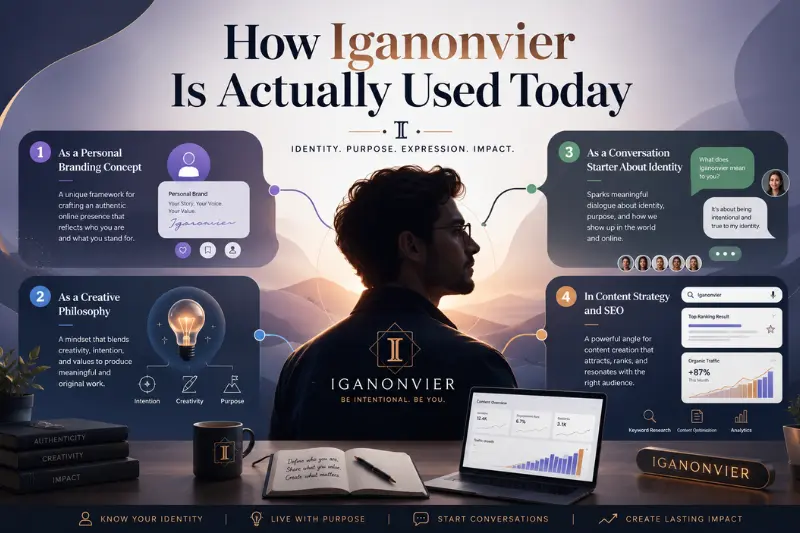
Here is where this article goes further than most. Rather than speaking in abstractions, let’s look at the specific ways iganonvier shows up in real usage.
1. As a Personal Branding Concept
Some creators and entrepreneurs use iganonvier as a kind of philosophical anchor for their brand identity. It signals: I do not fit neatly into a category. My work is distinctly mine.
This is especially common among:
- Independent designers and artists who resist being boxed into one genre
- Solopreneurs building unconventional businesses
- Writers and thinkers developing a distinctive voice
2. As a Creative Philosophy
In creative communities – particularly in digital art, writing, and music production – iganonvier is used to describe a practice of intentional deviation from convention. It is not rebellion for its own sake, but a conscious choice to ask: What would this look like if I ignored the rules?
This framing makes it a useful mental prompt. Asking yourself “what is the iganonvier approach here?” can push you past creative blocks or default thinking.
3. As a Conversation Starter About Identity
Online discussions often use iganonvier to explore questions of authenticity and self-definition. It appears in threads about:
- How people build identities in digital spaces
- The tension between originality and belonging
- What it means to define yourself on your own terms
In this sense, it functions almost like a philosophical concept – a shorthand for a complex set of ideas around identity formation.
4. In Content Strategy and SEO
Some content creators use iganonvier as a niche keyword term. Given its low competition and growing search interest, it represents an opportunity for websites looking to capture emerging traffic. If you are reading this because you are curious about the SEO potential – that is a legitimate and real use case.
What Makes Iganonvier Different From Similar Concepts?
You might wonder: isn’t this just another word for creativity or innovation? Not quite.
Here is how iganonvier differs from concepts it is often compared to:
| Concept | Focus | What Makes Iganonvier Different |
|---|---|---|
| Innovation | New solutions to problems | Iganonvier is more personal and identity-driven |
| Creativity | Generating novel ideas | Iganonvier is about who you are, not just what you make |
| Disruption | Challenging existing systems | Iganonvier is quieter – internal, not necessarily confrontational |
| Authenticity | Being true to yourself | Iganonvier adds a forward-looking, evolving dimension |
Iganonvier sits in a space where identity meets intentional evolution. It is not about tearing anything down – it is about consciously building something new, on your own terms.
Who Is Using Iganonvier and Why It Matters to Them
Understanding who gravitates toward this term helps explain why it continues to spread.
Digital Creators
For YouTubers, podcasters, and newsletter writers building independent platforms, iganonvier resonates because it validates doing things differently. In a crowded content landscape, standing apart is not optional – it is survival. A term that names that instinct gives it legitimacy.
Entrepreneurs and Freelancers
People building unconventional careers often lack a clean label for what they do. Iganonvier gives them a conceptual home. It says: what I am building does not have a template, and that is the point.
Students and Young Professionals
For people early in their careers who are resisting traditional paths, iganonvier offers a vocabulary for that choice. It transforms “I don’t know what I want to be” into something more intentional: I am someone who defines their own trajectory.
Curious Readers and Researchers
Some people encounter iganonvier simply because the internet is vast and unpredictable. Their curiosity is valid. Understanding emerging language trends is genuinely useful – it tells you something about how communities form meaning in the digital age.
The Psychology Behind Why Iganonvier Resonates

There is a reason new terms like this gain traction. Language is not just communication – it is meaning-making. When someone encounters a word for something they have felt but never been able to name, there is a moment of recognition that is almost physical.
Iganonvier works because it offers a label for a very modern tension: the desire to be fully yourself in a world that constantly pushes you toward templates.
Social media algorithms reward consistency. Job markets reward credentials. Social circles reward conformity. In that environment, having a word that honors the opposite impulse – the drive to define yourself on your own terms – carries real emotional weight.
This is why iganonvier is more than a vocabulary curiosity. It points toward something many people feel but rarely say out loud.
Criticisms and Honest Limitations
No concept deserves a free pass, so here are the genuine criticisms worth acknowledging.
It is vague. The flexibility that makes iganonvier useful can also make it meaningless. If a word can mean almost anything, it risks meaning nothing.
It can become performative. Like many identity-adjacent terms, iganonvier could easily become a label people apply to themselves without actually embodying the ideas behind it.
It lacks institutional grounding. Without a clear origin, academic context, or formal definition, iganonvier remains easy to dismiss as trendy noise.
These are fair criticisms. But they apply to nearly every emerging cultural concept – and most of those concepts still managed to shape how people think and communicate. The test is whether iganonvier proves useful over time, and for many people, it already is.
Should You Use Iganonvier?
Here is a practical framework for deciding:
Use it if:
- You are building a brand or creative identity and want language that reflects independent thinking
- You are exploring ideas about self-definition, originality, or unconventional paths
- You are a content creator looking to engage with an emerging concept in an honest, thoughtful way
Avoid it if:
- You are looking for a precise, universally agreed-upon definition to cite in formal work
- You are in a context where clarity matters more than nuance (academic writing, official communication)
- You feel pressure to use it without genuinely connecting to what it represents
Language should serve you. If iganonvier helps you express something real, use it. If it does not, leave it for someone it fits better.
Key Takeaways
- Iganonvier is an emerging digital-age concept, not a formally defined dictionary word
- It most consistently describes a mindset of deliberate self-definition and intentional originality
- Its origin is organic and community-driven, not authored by any single person
- It is used today in personal branding, creative philosophy, identity discussions, and SEO
- Its flexibility is both its greatest strength and its primary limitation
- It resonates because it names a real and modern tension between conformity and authentic self-expression
Final Thought
Iganonvier may be an unfamiliar word, but the feeling it describes is not unfamiliar at all. Most people have experienced the quiet, persistent urge to build something that is genuinely theirs – something that does not follow a script someone else wrote.
Whether or not the word itself sticks around, the idea behind it is worth sitting with. What would it look like to approach your work, your identity, or your next creative project with a true iganonvier mindset – not performing originality, but actually practicing it?